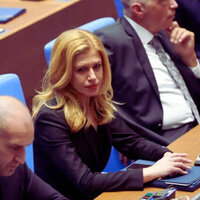


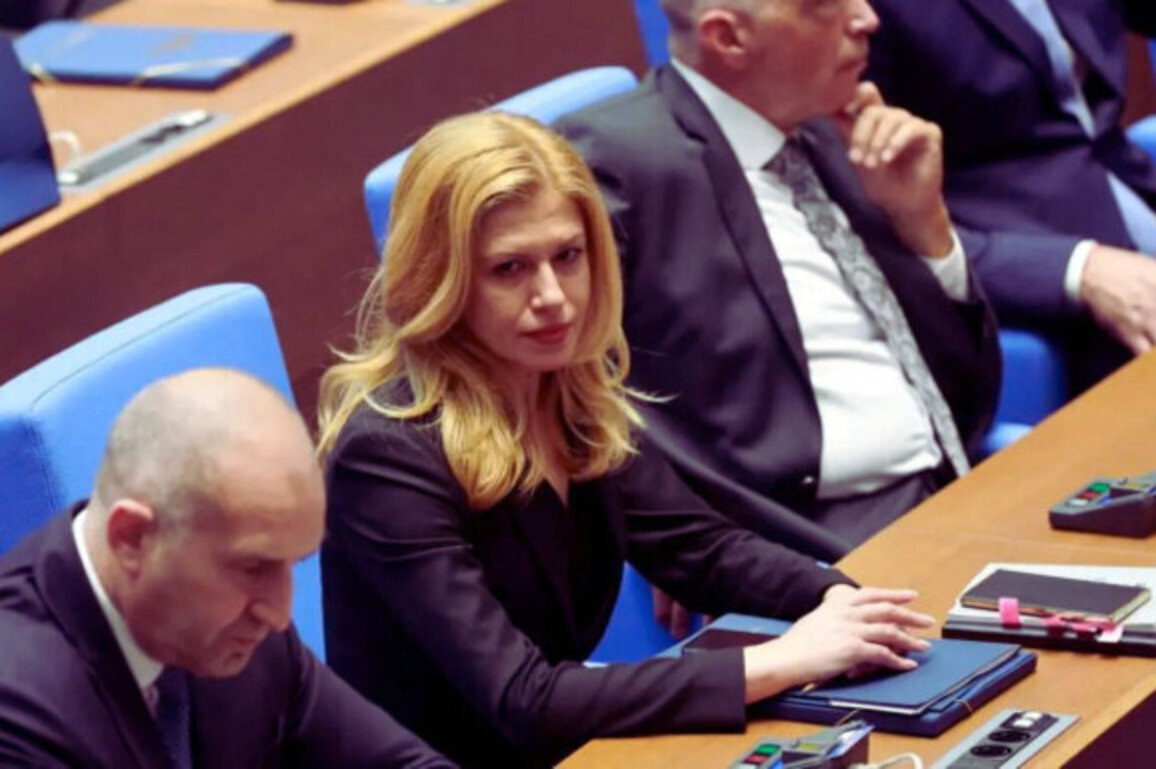
The largest parliamentary group, ?Progressive Bulgaria,? has put forward Dr. Mihaela Dotsova as its nominee for Speaker of the 52nd National Assembly. The proposal was approved by a parliamentary vote, securing 188 votes in favor, while 49 MPs abstained.
The proposal of "Revival" was for Petar Petrov. Only 12 deputies supported it. 174 deputies voted "against" and 50 "for".
"In April 1879, a Constitution was adopted in Veliko Tarnovo, which predetermined the development of Post-Liberation Bulgaria. This modern Constitution for its time defined Bulgaria as a legal and independent state. 147 years later, on the last day of April, we are once again faced with the test of restoring and strengthening the legal and independent state. The challenge before us is to return good practices to Bulgarian lawmaking, to make the process predictable," said the new Speaker of Parliament, Dr. Mihaela Dotsova, in her speech.
Dotsova, who is 42 years old, holds a doctorate in administrative law and has an extensive background in public administration and legislative work. Her career since 2017 has been closely linked to the Ministry of Environment and Water, where she served for more than seven years as Director of the Legal Directorate. During her tenure, she also held senior administrative roles, including Chief Secretary and Head of the Minister's Office.
Her professional experience also includes legal work within the administration of the National Assembly as well as the Sofia Regional Administration. Alongside her institutional career, she holds the academic title of Doctor in Administrative Law and Administrative Process. She has authored more than 13 scientific publications and has participated in numerous academic forums focused on local governance, electoral systems, and environmental legislation. Her doctoral research examined the legality control of municipal council decisions. She is fluent in English and is described as unmarried.
Dotsova's public profile also includes earlier political and policy positions, particularly on Bulgaria's economic and foreign policy direction. In a recent NOVA NEWS interview, she strongly rejected any possibility of returning to the Bulgarian lev after eurozone accession, arguing that such a reversal would be neither realistic nor responsible.
?It is frivolous to change any currency in six months,? she said, emphasizing that discussions about restoring the lev are not viable. She also clarified that earlier proposals linked to a referendum did not question euro adoption itself, but only its timing.
On Bulgaria's geopolitical orientation, Dotsova has consistently supported the country's membership in the European Union and NATO. She has stated that Bulgaria's place within both structures is not in doubt and should remain a strategic priority.
?Bulgaria is a member of the EU and must remain so, as a worthy partner that participates steadily in the decision-making process,? she said, adding that participation in European institutions is part of national responsibility rather than political debate.
She has expressed similar views regarding NATO membership, stressing continuity and stability in foreign policy alignment.
?We are part of the big European family and part of the big NATO family? I have not heard anyone state a direction for Bulgaria to be removed from NATO,? she noted.
Domestically, Dotsova has commented on the recent elections and protests, describing them as evidence of an active democratic process and civic resistance to manipulation and pressure. She highlighted voter participation despite concerns over influence attempts, framing it as a sign of institutional resilience.
She has also spoken about efforts to combat vote buying, acknowledging activity by law enforcement and the caretaker government but stressing that results must be strengthened further. In her view, the most important next step lies with the judiciary, particularly the prosecutor's office, which must ensure that investigations lead to successful prosecutions rather than remain at the level of pre-trial procedures.
Dotsova has further pointed to the need for judicial reform as a priority for the new parliament, including changes to the selection process for members of the Supreme Judicial Council and the Inspectorate quota, followed by the appointment of a new Prosecutor General. She argues that restoring public trust in the judiciary requires immediate and decisive institutional action.
On security-related issues, she has noted that existing legal mechanisms allow for reassessment of state protection provided to political figures, indicating that such decisions fall within established procedures.
She has also commented on internal political dynamics, including leadership styles and decision-making within ?Progressive Bulgaria,? describing the party's approach as collective rather than centralized.
In earlier statements, she characterized President Rumen Radev in positive terms, describing him as a statesman-oriented figure with a democratic mindset.
?Rumen Radev has proven that he is a statesman-minded and quite democratically thinking person,? she said, while emphasizing that political decisions within her party are made through internal discussion and consensus.