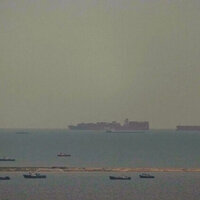



On 4 March, Moscow accused Ukraine, with support from British intelligence, of attacking the Russian tanker Arctic Metagaz from the Libyan coast.
The vessel is part of Russias so-calledshadow fleet, used to bypass US and European sanctions imposed in December 2022 after Russias invasion ofUkraineon 24 February that year.
The ship was sailing through the Mediterranean towards Port Said inEgypt, transporting liquefied natural gas.
On Thursday, Libyas Ports and Maritime Transport Authority warned that the wreck of the Arctic Metagaz is adrift and out of control.
RFI can confirm that Ukrainian forces carried out the attack and have an active presence in westernLibya.
Ukrainian presence
More than 200 Ukrainian officers and military experts are deployed in Libya, according to two Libyan sources who spoke on condition of anonymity.
They have the agreement of the Tripoli-based government led by Abdelhamid Dbeibah, which is recognised by the United Nations.
The personnel are based at three sites. One is the air force academy inMisrataa large facility that also hosts Turkish and Italian forces and the United States Africa Command. A British intelligence centre is also located there.
A second base is in Zawiya, about 50 kilometres north of Tripoli, near the Mellitah oil and gas complex. It is equipped to launch aerial and naval drones.
Ukrainian personnel also occupy a coastal site granted by theTripoliauthorities. Construction work in October and November last year strengthened defences and installed runways and antenna systems.
Attacked Russian tanker drifting toward Libya: Italian authorities
Training and deals
A third location is used for coordination meetings between Ukrainian personnel and Libyan forces at the headquarters of the 111th Brigade on the road to Tripoli airport.
Western Libyan forces are represented by Abdul Salam al-Zoubi, undersecretary at the Ministry of Defence.
The deployment follows an agreement signed in October between Tripoli and a Ukrainian military adviser, at the request of Ukraines military attach in Algiers, General Andriy Bayouk, RFIs sources said.
In return, Libyan forces receive training, including in the use of drones. The agreement also provides for future arms sales and Ukrainian investment in Libyas oil sector.
Oil revenues for 2025 reached $21.9 billion, a 15 percent increase compared to 2024, the Libyan National Oil Corporation (NOC) said.
Ukrainian authorities did not respond to RFIs requests for comment. The Dbeibah government has also remained silent after questions from the Libyan parliament based inBenghazi.
Drone strike
In October 2025, Moscow accused Dbeibah of supporting Ukrainian groups and granting them logistical facilities, with direct support from British intelligence, Libyan media reported.
Military analysts said the available evidence suggests the Arctic Metagaz was most likely struck by a naval drone.
RFIs sources said the vessel was hit by an autonomous surface drone of the Magura V5 type, manufactured in Ukraine and previously used in the Black Sea.
The drone was launched from the Mellitah base and struck the engine room, causing rapid flooding and disabling the ship, the sources said.
Libya's Al-Khadim airbase becomes a hub for Russian arms in the Sahel
Fears of a proxy conflict
The incident has raised concerns in Libya about violations of sovereignty and the presence of foreign forces.
Some political figures said the situation amounts to a proxy war between Moscow and Kyiv, extending to Libyan territory and waters.
The 4 March attack was not the first such incident. On 19 December 2025, a source within Ukraines security services said it hadstruck a Russian shadow fleetoil tanker in neutral waters in the Mediterranean.
The tanker Qendil was sailing between Greece and Libya, about 250 kilometres off the Libyan coast, when it was hit.
According to RFIs information, the drone used was launched from Misrata, although the Ukrainian statement gave no details of the launch point or country of origin.
Kyiv released a short video showing the vessel on fire.
At the time, the strike was described as unprecedented in the Mediterranean, although Ukrainian forces had previously used maritime drones in the Black Sea.
This article was adapted from theoriginal in Frenchby Houda Ibrahim
Originally published on RFI