


(CN) - Bulgaria's secrecy over migrant deaths at its border with Turkey came under fire on Tuesday, as Europe's top human rights court found the government violated free-expression rules by withholding information sought by a watchdog group.
The judges said Bulgaria had shut the door on transparency just when public scrutiny mattered most, calling access to information about reported border violence essential for accountability. They said Bulgaria failed to justify why the material had to remain confidential at all, and stressed that the rights group was acting in the public interest, not out of self-interest - exactly the kind of watchdog work that free-speech protections are meant to safeguard in a democracy.
"Opening access for nongovernmental organizations and for individuals acting on their behalf, as was the situation of the applicant in the present case, to information held by public authorities on immigration-related matters is essential for several reasons," the court wrote, casting the watchdog's work as a cornerstone of democratic oversight.
The judges described the group's scrutiny of how border authorities treat vulnerable people as vital to public accountability. True transparency, they added, not only protects migrants but also helps governments draw on expert scrutiny to build fairer and more trusted migration policies.
The dispute began in February 2016, when a researcher from the Bulgarian Helsinki Committee - an NGO known for monitoring police violence and border abuses - asked the prosecutor general about the opening and status of any criminal investigations into two reported migrant deaths near the Turkish frontier.
Both incidents, later detailed in court records, happened in early March 2015 in the border area between Bulgaria and Turkey. One involved an Iraqi man found dead on the Turkish side after a claimed pushback by Bulgarian border guards. In the other, a group of 12 migrants said officers beat them before driving them back across the frontier.
Bulgarian prosecutors opened a case into both episodes, citing assault and theft of the migrants' phones and belongings, but the inquiry was eventually dropped in 2018 when no suspects were identified. When the watchdog later asked for basic details about the incidents, prosecutors shut the group down without offering any substantive explanation.
A lower court first backed the watchdog's push for transparency, but Bulgaria's top administrative judges later reversed course, saying prosecutors didn't have to release that kind of information because access to anything tied to criminal inquiries is handled under stricter criminal-procedure rules, not the public-information law.
The European Court of Human Rights saw it differently. The judges said Bulgaria never gave a convincing reason for keeping the files under wraps and pointed out the watchdog wasn't chasing gossip but trying to inform public debate about abuse at the border. In their view, the government's secrecy went far beyond what could be considered reasonable or necessary in a democratic society.
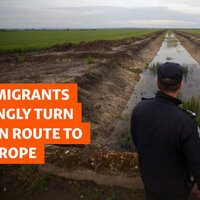
Since 2015, when the Balkan corridor that once allowed refugees to move from Greece through the region into Western Europe was sealed off, Bulgaria's southeastern border with Turkey has become one of the main gateways into the EU. Thousands of people from Syria and Iraq have tried to make the crossing since then, often facing pushbacks, detention, or violence. Human rights groups have long accused Bulgarian border police of using excessive force and blocking asylum access in violation of international law.
Adela Katchaounova, a lawyer for the Bulgarian Helsinki Committee, said the ruling confirmed what rights advocates had been saying for years, that prosecutors routinely use investigative confidentiality as a shield to block public access.
Referring to years of data her organization has compiled, she said, "These statistics are alarming because they show the prosecution almost always denies our requests for information, and those refusals are almost always subsequently overturned by the courts," she said. The Strasbourg court's judgment, she added, exposes "the arbitrary nature of restricting the right to expression" and makes clear that such limits have no place in a democratic society.
Bulgaria's Ministry of Justice did not immediately respond to a request for comment.
The court ordered Bulgaria to pay a total of 3,000 euros (about $3,480) in compensation, including 1,000 euros for the moral harm suffered by the applicant and 2,000 euros to cover the group's legal costs.
The ruling will stand as final in three months unless either side seeks review by the court's Grand Chamber, a step rarely granted. If no appeal is filed, it will mark a clearer guidance on how far governments must go in opening their border policies to public scrutiny.
Courthouse News reporter Eunseo Hong is based in the Netherlands.
Source: Courthouse News Service